Sometime in 2026, AI entered an important second phase.
The first phase was experimentation at grand scale. Companies rushed to deploy models from frontier labs, mostly Anthropic and OpenAI, and for good reason: they are an incredible capability, easy to deploy and the fastest way to find out what AI could do for the business. Rapid adoption of chat and agentic coding followed, at a pace perhaps never seen before in technology history, across both startups and Global 2000 enterprises.
The second phase has been shaped by two forces. One is a brutal awakening to what it costs, in dollars and in dependency, to build your company on top of a duopoly. As everyone started tokenmaxxing in late 2025 and early 2026, bills started rapidly escalating (fueling in large part the meteoric rise of Anthropic’s ARR). As companies built their first agentic workflows, it became very apparent that agents burn tokens at a rate chat never quite did, resulting in costs scaling with their success. And a model built for everyone never learns the company’s workflows, tools or edge cases.
The other force is the steady progress of frontier open-weight models, from the Chinese labs and from a rising generation of Western ones: NVIDIA’s Nemotron (see our MAD Podcast episode here), Reflection, Thinking Machines, Mistral (see our MAD Podcast episode here) and others.
The stack is going hybrid
Put those two forces together and you get a realization: it is both desirable and possible for companies, whether AI-native startups or large enterprises, to run models they own alongside the frontier ones, trained on their most proprietary data and workflows. Take an open-weight model, post-train it on your own work, and you end up with something smaller, faster and (generally) cheaper that beats the generalist models at your specific job.
The result is in an increasingly hybrid stack: a combination of closed-source frontier AI models that companies rent, and customized post-trained open weight models that they own.
The catch is that the latter is very hard to do. Post-training takes serious compute and, above all, training environments: the tasks, rewards and verifiers a model practices against in order to improve. Those are still mostly built by hand, one customer at a time.
And it takes people who have done it before. They are scarce, most of them work inside a handful of labs, and everyone is fighting to hire them.
Turning agent traces into models you own
As they deploy agents, enterprises create plenty of raw material for post-training. Each time an agent completes a task, or fails at one, it leaves a trace: what it tried, which tools it called, where it went wrong. If you multiply that by millions of runs, you get a detailed record of how a company's work actually gets done. Today almost all of it is thrown away.
Those traces are an incredible representation of how a company works, and the richest training signal it has. They can be converted into training environments that replay the situations an agent actually faces, and those environments can be used to post-train an open-weight model through reinforcement learning. The model practices on the company's real work until it gets it right.
The beauty is that it can be turned into a continual learning loop: as new traces come in, the model is retrained, so it keeps improving as workflows change. The more work agents do, the better the model becomes and the better the agents do the work. The result: intelligence that compounds with use, and belongs to the company that generated it.
Enter Remanence
Remanence is building that continual learning loop as a platform that any company can use. It plugs into a company's existing agents and automates the hard part: generating tailored training environments from their execution traces, then post-training open-weight models on them. The customer owns the weights. The data can stay inside their own infrastructure, and training and deployment happen wherever they choose, cloud, VPC or cloud.
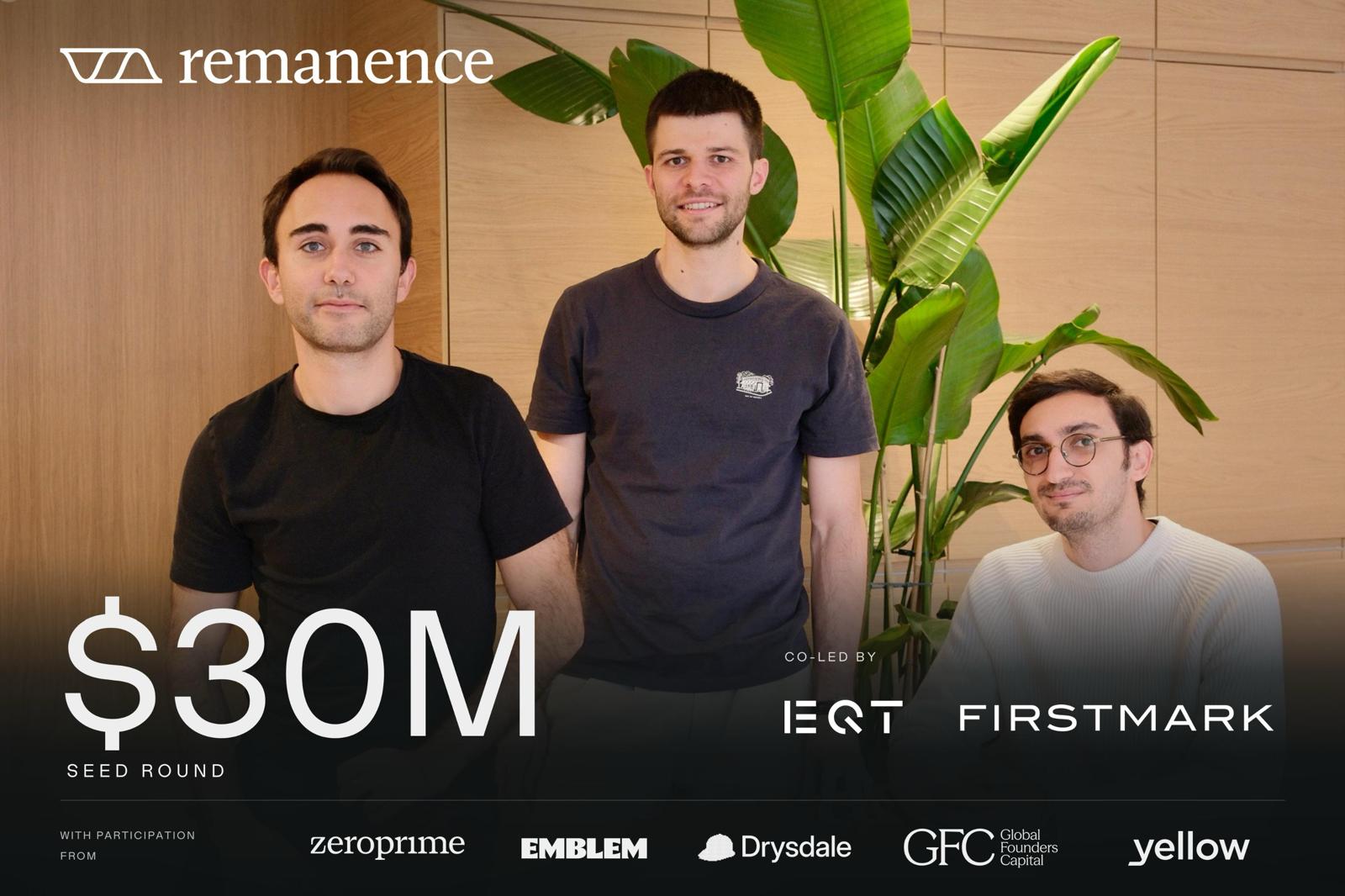
Today, I'm excited to share that FirstMark is co-leading Remanence's $30M seed round with EQT Ventures, alongside Zero Prime, Emblem, Drysdale, Global Founders Capital and Yellow, and a great group of angels including Olivier Pomel (Datadog), Philippe Corrot (Mirakl), Romain Niccoli (Pigment), Victor Riparbelli and Steffen Tjerrild (Synthesia) and Mehdi Ghissassi (AI71).
A team that has done it before
Frontier AI level talent able to post-train models is incredibly rare. The 3 co-founders of Remanence, Pierre-Louis Cedoz, Hamza Benchekroun and Axel Moyal belong to the very small group of people around the world that have deep experience doing it. They worked together at H Company, France's computer-use AI lab, where they led the post-training of the open-weight Holo models, which outperformed leading open and closed models on computer-use benchmarks. Between them they also bring experience from Google DeepMind, InstaDeep and Meta.
They are now building Remanence to turn everything they have learned, the hard way, into a product every company can use.
Remanence is based in Paris, with an early presence in London and San Francisco. At a time when the vibes on European tech have shifted for the worse, we continue to be very excited to back world-class European technical founders with global ambitions and immediate relevance to the US market, in the vein of our investments in Synthesia, Dataiku, Pigment and Gradium, and it says something that founders from two of those companies are angels in this round. We're thrilled to partner with Pierre-Louis, Hamza and Axel from day one, alongside our friends at EQT Ventures.
What comes next
The funding will go to research, a dedicated GPU cluster, and the hard engineering of environments, evaluation and post-training. Right off the bat, Remanence is already working with design partners in legal, customer support and enterprise software across Europe and the US.
If you want to own and customize your own AI, and turn your company’s workflows and knowledge into a compounding asset, you should talk to them.
And, of course, if you're a researcher or engineer who wants to work on reinforcement learning for real-world workflows, or an ambitious GTM person, Remanence is hiring.